
Istanbul Sabahattin Zaim University began teaching in the 2011-2012 academic year. The IZU Library opened for service at the same time.
We aim to continuously improve ourselves in order to support the University's education and teaching activities as effectively as possible. With this in mind, alongside printed books, periodicals and similar resources, we also provide a substantial number of electronic databases.
With a gross area of 13,500 m2 and capacity for more than 1,000 users at the same time, our Central Library is one of the largest libraries in Istanbul. Our printed book collection has exceeded 130,000 volumes. Together with the electronic books made available, our total number of books exceeds half a million.
Our students and staff can also access electronic resources from off campus.
Catalogue Search
To find out whether a particular book is available in the library, or which resources the library holds on a given subject, we need to carry out a “catalogue search”.
We search by typing the keyword we are looking for into the field marked “Enter your search”. We can search for the keyword generally, without restricting it to a field, or we can search by selecting one of the fields such as “title, author, contributors, subject headings, classification, ISBN”. If the resources we are looking for are held in the library, a list will appear on the screen. When we click on an entry in the list, the catalogue information for that publication will be displayed.
Reading Catalogue Information
In order to locate a publication using the catalogue information, we need to pay attention to the details given under the classification and status headings.
Classification and Status information
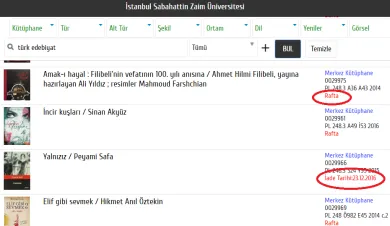
This is the information showing exactly which shelf and which position the work we are looking for is in. In the sample image below, in order to find the work titled “Amak-ı hayal”, the information on the right-hand side (PL 248.3 A36/A43) should be noted. In addition, the “on shelf” and “due date” details marked in the image below tell us whether the works are in the library or on loan. If it says “on shelf”, the book is in the library; if it shows a “due date”, the book is on loan.
LC Classification System (Library of Congress Classification)
In the LC Classification System, the letters A to Z are used to represent subjects.
In this system, subjects are represented by the following letters;
A - General Works
B - Philosophy, Psychology, Religion
C - Auxiliary Sciences of History
D - History of the World, Europe, Asia, Australia, New Zealand, etc.
E - History of America
F - History of America
G - Geography, Anthropology
H - Social sciences
J - Political science
K - Law
L - Education
M - Music
N - Fine arts
P - Language and Literature
Q - Science
R - Medicine
S - Agriculture
T - Technology
U - Military science
V - Naval science
Z - Bibliography, Library Science, General information resources
Shelf Arrangement and Locating the Book You Are Looking For:
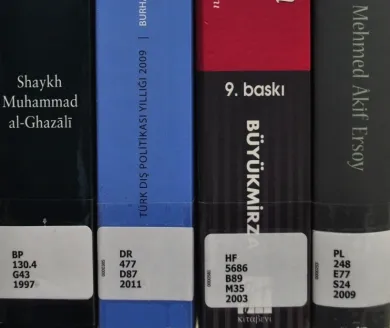
Books are arranged alphabetically on the shelves according to the “Classification” letters and numbers printed on the labels on their spines. Just as in dictionaries, the letters are ordered from A to Z, while books carrying the same letter (or letters) are ordered according to the numbers on the following line. If both the letters and the numbers are identical, the information on the next line is taken into account.
For example, in the LC Classification System the letter “D” denotes works in the field of history. Adding further letters to “D” creates sub-headings within the field of history. For instance, the subset “DR”, formed by adding the letter “R”, covers Eastern Europe, the Balkan Peninsula and Turkey. The number following “DR” forms the next subset. For example, “DR 439” contains works on General Turkish History.
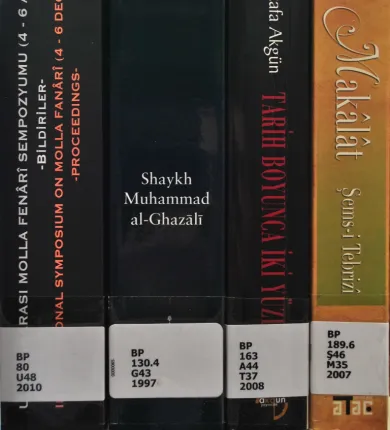
Above, the books with the “BP” classification are arranged from left to right in ascending numerical order. Classifications with lower numerical values are placed further to the left. Please consult the librarians for books you are unable to find.
Books you have used should be left on the table rather than reshelved.